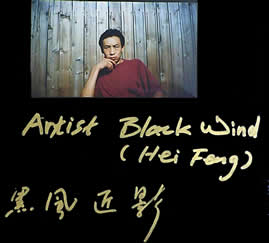
The artist, Hei Feng, "Black Wind", was injured during the bloody events of June 3-4, 1989 in Beijing , China , when the troops of the People's Liberation Army murdered thousands of unarmed student protesters as well as thousands of Beijing citizens who were expressing their support. Now he immortalizes this turning point on the road that China has taken towards its future, depicting the great Square, largest in the world, in its centrality to Chinese politics since the end of the Imperial Manchu dynasty in 1910. At the upper left, we see students in Tiananmen launching what came to be called the May Fourth Movement in 1919, beginning the long sequence of mass activism in quest of nationalism. In chains is Li Dazhao, Beijing University librarian, leader of the May Fourth Movement, a co-founder of the Chinese Communist Party, who was hanged in 1927. In the lower left corner are scholars and intellectuals undergoing public humiliation during Mao's vicious Cultural Revolution from 1966-1976. Women were sometimes especially maltreated by having their heads shaved and being partially stripped. In the central panel, the sun itself shines below the Heavenly Date, a mere subordinate body to the dream of total imperial power shared b Yuan Shih Kai and Mao Zedong above. Yuan, once a reformist Imperial general, murdered many in his quest to establish himself as the new Imperial Emperor. Like Mao, he is roped onto this infantile idea, symbolized by the naked baby Pu Yi, the last emperor, seeking to enter the Forbidden City under the portrait of a ghoulish Mao. Below, dancing on a lethal tank, are three nudes in innocent credulity brandishing the mass murderer's absurd little Red Book. Stirrings of humanity resumed with the memorial service to the popular moderate Chou Enlai on April S, 1976. Spontaneously, an enormous crowd gathered In Tiananmen Square, saying not a word for fear of the secret police, but wearing politically Incorrect (the soul does not exist) black armbands. FInally we see tbe students of April-June 1989 and their protest banners. More than 100,000 people camped out in the Square, where they sand and cheered the speeches of young idealists at the base of their plaster covered styrofoam Goddess of Democracy. Brutalizing them are the troops with their tanks and rifles, countryside peasants in uniform kept Ignorant of the meaning oftheir actions. Deng Xiaoping drinks a bloody toast to the events. Overhead, airborne skulls recall the long legacy of death imposed by the imperial ideal in its suppression of humanity and democracy. Black wind has in this towering work exorcised the ghosts and nightmares of China 's struggle to find the light. Thus also does he demonstrate the victory of art and spirit over fear and blindness. By Ron Behling |

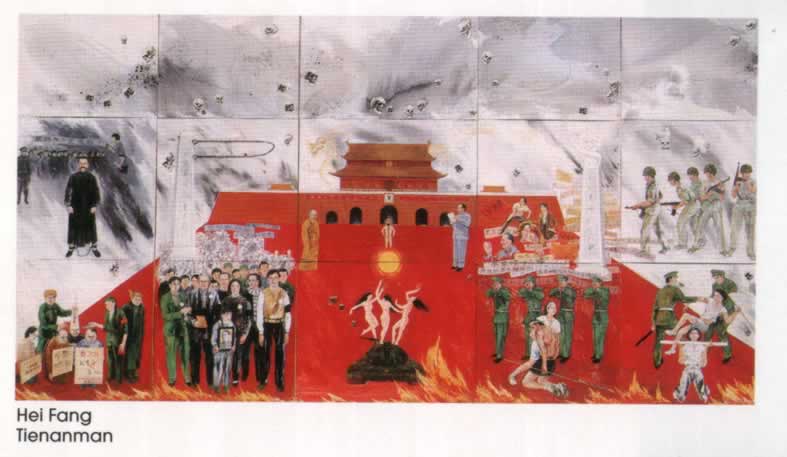
In the spring of 1989, Beijing erupted with the largest spontaneous demonstrations the Peoples' Republic of China had witnessed in its 40-year history. The pro democracy movement spread to 30 cities around China before the world witnessed the horrors of the government's brutal crackdown. As the Chinese people fled from the tanks and guns, they asked the international press to let the world know the truth.
|
 |
 |